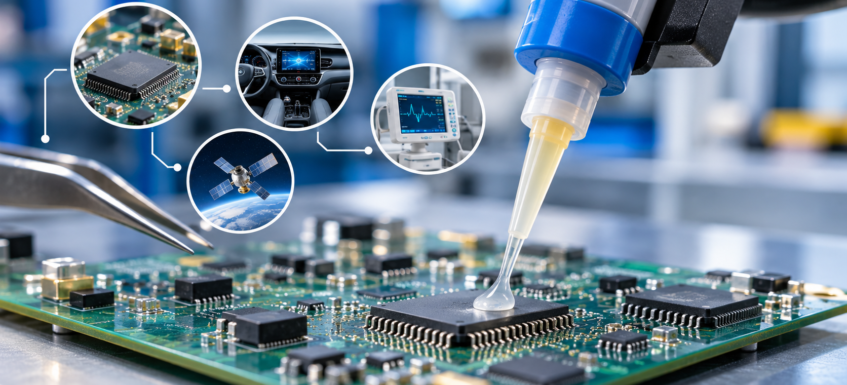
The electronics manufacturing industry is constantly evolving as devices become smaller, more powerful, and increasingly complex. From consumer electronics and communication equipment to automotive electronics and industrial control systems, manufacturers face growing challenges in assembling components that require precision, durability, and reliable performance.
While circuit design and component quality receive considerable attention, the materials used during assembly are equally important. Industrial adhesives have become essential in modern electronics manufacturing, helping secure delicate components, protect sensitive circuits, and improve the overall reliability of electronic products.
Why Adhesives Are Important in Electronics Manufacturing
Electronic assemblies contain numerous small components that must remain securely positioned throughout the product’s lifecycle. Traditional fastening methods are not always practical because of limited space, lightweight materials, and sensitive electronic structures.
Specialised adhesives provide an effective alternative by creating strong bonds without requiring mechanical fasteners. They can also offer additional benefits, including electrical insulation, vibration resistance, moisture protection, and thermal management.
Depending on the application, manufacturers may use epoxy adhesives, silicone materials, polyimide formulations, or other specialised bonding compounds. Selecting the appropriate material depends on the component design, operating environment, and manufacturing process.
Working with an experienced adhesive manufacturer in India can help electronics manufacturers identify suitable formulations for specific bonding and protection requirements.
The Role of Epoxy Adhesives in Electronic Assemblies
Epoxy adhesives are widely used in electronics because of their mechanical strength, chemical resistance, and formulation flexibility. They are suitable for applications where components require secure bonding and long-term structural stability.
Some common applications include:
- Component bonding: Securing electronic components to substrates and other surfaces.
- Potting and encapsulation: Protecting sensitive circuits from moisture, dust, chemicals, and environmental exposure.
- Die attachment: Supporting semiconductor assembly by bonding silicon dies to suitable substrates.
- Connector assembly: Providing reliable bonding for electrical connectors and related components.
- Protective coatings: Helping protect electronic assemblies from external environmental conditions.
Different applications require different adhesive properties. For instance, a formulation used for semiconductor packaging may have different viscosity, curing, and thermal requirements compared with one used for general electronic component assembly.
Managing Heat in Modern Electronic Devices
As electronic devices become more compact, heat management has emerged as a significant manufacturing consideration. Processors, power modules, circuit boards, and other electronic components generate heat during operation. If this heat is not managed effectively, it can affect component performance and product lifespan.
Thermal adhesives play an important role in addressing these challenges. Depending on their formulation, they can facilitate heat transfer, provide thermal insulation, or maintain bonding strength under elevated temperatures.
A suitable high temperature epoxy can be useful in electronic assemblies that experience continuous heat exposure or repeated temperature fluctuations.
Manufacturers should also consider parameters such as thermal conductivity, glass transition temperature, coefficient of thermal expansion, and curing requirements when selecting an adhesive for heat-sensitive applications.
Importance of Precision in Adhesive Application
Modern electronic components often have extremely small dimensions, making accurate adhesive application essential. Excessive adhesive, uneven dispensing, or improper curing can affect assembly quality and potentially damage sensitive components.
Manufacturers should consider several factors when developing an adhesive application process:
1. Viscosity and Flow Characteristics
The adhesive should have suitable flow properties to reach the intended bonding area without spreading into unwanted regions.
2. Curing Time
Curing requirements influence production speed and manufacturing efficiency. Selecting a formulation compatible with the available production process can help maintain consistent output.
3. Material Compatibility
Adhesives must be compatible with substrates such as metals, ceramics, plastics, and electronic-grade materials.
4. Thermal Stability
Electronic assemblies may experience temperature variations during manufacturing and operation. Adhesives should maintain their required properties under the expected conditions.
5. Long-Term Reliability
Bonding materials should be evaluated for resistance to vibration, moisture, chemicals, and other environmental factors relevant to the application.
Emerging Requirements in Electronics Manufacturing
The growing adoption of electric vehicles, automation systems, smart devices, and advanced communication technologies is creating new requirements for electronic assembly materials.
For example, electric vehicle electronics require materials that can withstand demanding thermal and mechanical conditions. Industrial automation equipment needs reliable bonding solutions that support continuous operation. Meanwhile, compact consumer devices require adhesives that deliver dependable performance without adding unnecessary weight or bulk.
These developments are encouraging adhesive manufacturers to invest in specialised formulations and application-specific research.
Custom-engineered adhesive solutions are particularly useful when standard products cannot meet the combined mechanical, electrical, and thermal requirements of a particular assembly.
Choosing the Right Adhesive Manufacturing Partner
Selecting an adhesive supplier involves more than comparing product specifications. Manufacturers should evaluate technical expertise, product consistency, formulation capabilities, and the availability of application support.
Kohesi Bond develops custom-engineered epoxy, polyimide, and sodium silicate-based adhesives, sealants, coatings, and potting compounds for specialised industrial applications. Its portfolio includes more than 300 grades designed for industries such as electronics, aerospace, medical, optical, and automotive manufacturing.
As an experienced adhesive company in India, Kohesi Bond offers specialised material solutions to address different industrial bonding and protection requirements.
Conclusion
Adhesives have become an important part of modern electronics manufacturing, supporting everything from component assembly and circuit protection to thermal management. As electronic products become more compact and technologically advanced, the demand for specialised bonding materials will continue to increase.
Manufacturers who carefully evaluate adhesive properties, application requirements, and operating conditions can improve assembly reliability and product performance. Choosing suitable formulations and working with technically capable manufacturing partners can also support consistent production quality and long-term product durability.
*
*